
Records Behind a Lacey Township Resident Lookup
No single record answers the question of who lives somewhere. A parcel file gives an address or assessment lead. A deed names parties and an instrument date. A court result only shows a case connection. A historical directory or newspaper supplies a dated mention from a particular era. A careful resident lookup notes the source date every time. Trust the role printed on the record. Do not treat every hit as proof of current residence in Lacey Township.
| Record | What It Confirms | Where | Access |
|---|---|---|---|
| Assessor, tax, and GIS data | Parcel, address, assessment context, and possible ownership lead | Lacey, Ocean County, and NJGIN tools | Public tools; protected owner data can be redacted |
| Recorded instrument | Named parties, legal description, type, and recording date | Ocean County Clerk SearchNG | Free public index from Apr. 1, 1977 online |
| Voter check or lawful list request | Registration snapshot or controlled election data | NJ Voter Search and Ocean Elections | Individual check or OPRA/criteria process |
| Court index | Party, docket, venue, caption, and initiation lead | Lacey Municipal Court or NJ eCourts | Public access with confidential-case limits |
| Vital event | A specific birth, marriage, or death relationship or date | Lacey registrar, NJ DOH, or State Archives | Qualified request; no unrestricted name index |
| Directory or newspaper | Historical local mention at a stated date | OCL, Wheeler Room, OCHS | Database, library, or research-center rules |
Start with the source that fits the evidence. A street and a date point toward parcel and recorded-document searches. A case number goes to the correct court, while a family-history question usually begins at a library, historical society, or archive.
Set the Identity and Date Before Searching
Common names need more than one matching signal. Write down the full name and middle initial. Add spelling variants, an approximate year, and the municipality. Include the street or block and lot, plus the reason each source matters. Save the official URL and the retrieval date. Note any docket, book and page, clerk file, or archive page number too. A negative result means little. It only shows that one source, one spelling, and one date range produced no match.
For a possibly current address, set Lacey Township as the municipality in the tax-list or GIS route. Preserve the returned block, lot, and qualifier. The state parcel service searches by address, county, municipality, block, and lot. Daniel's Law may redact owner names, though. Next, search the county Clerk's index by legal description and party name. Then inspect the instrument date and linked documents. A tax or deed connection is not evidence of occupancy.
| SearchNG party result | Party names and roles, document type, recording date, book/page or clerk file number, and linked-document lead. |
|---|---|
| Tax-list query | Municipality, block, lot, qualifier, property class, and property location fields; no live Lacey result card was captured during research. |
| NJGIN parcel view | Parcel geometry, location attributes, values and descriptions, acreage, use/class, and sometimes deed book/page/date. |
| Archive or news result | Item title, date, place, page or article, database or collection, and the source’s access conditions. |
Verify a Lacey Township Address and Instrument
A strong address lookup keeps parcel administration, title, and occupancy in separate lanes. Lacey's assessor keeps ownership information and the tax map. Ocean County's tax search accepts Municipality, Block, Lot, Qualifier, Property Class, and Property Location. GIS adds the spatial layer. It covers parcel geometry, easements, right-of-way, imagery, zoning, flood, wetland, and tax-map context. SearchNG supplies the recorded-instrument layer. Its online official records begin April 1, 1977. Earlier material takes a clerk, book, microfilm, library, or archive route in Ocean County.
- Normalize the street name and query Lacey Township in the tax or GIS system.
- Record the legal identifier, block, lot, qualifier, and municipality, rather than only a mailing-style address.
- Search SearchNG by legal description, party names, and a defensible date range; test spelling variants.
- Read the instrument type, party role, recording date, book/page or file number, and linked documents.
- Describe the result as a parcel, recorded-party, or instrument lead unless a separate dated source supports something more specific.
SearchNG accepts a party name, second party, additional names, document group or type, date range, book and page, clerk file number, consideration amount, legal town, lot, and block, and map number. The party-name field adds an automatic wildcard. That makes namesake handling and tight date limits essential.
Read Court Names as Case Leads, Not Addresses
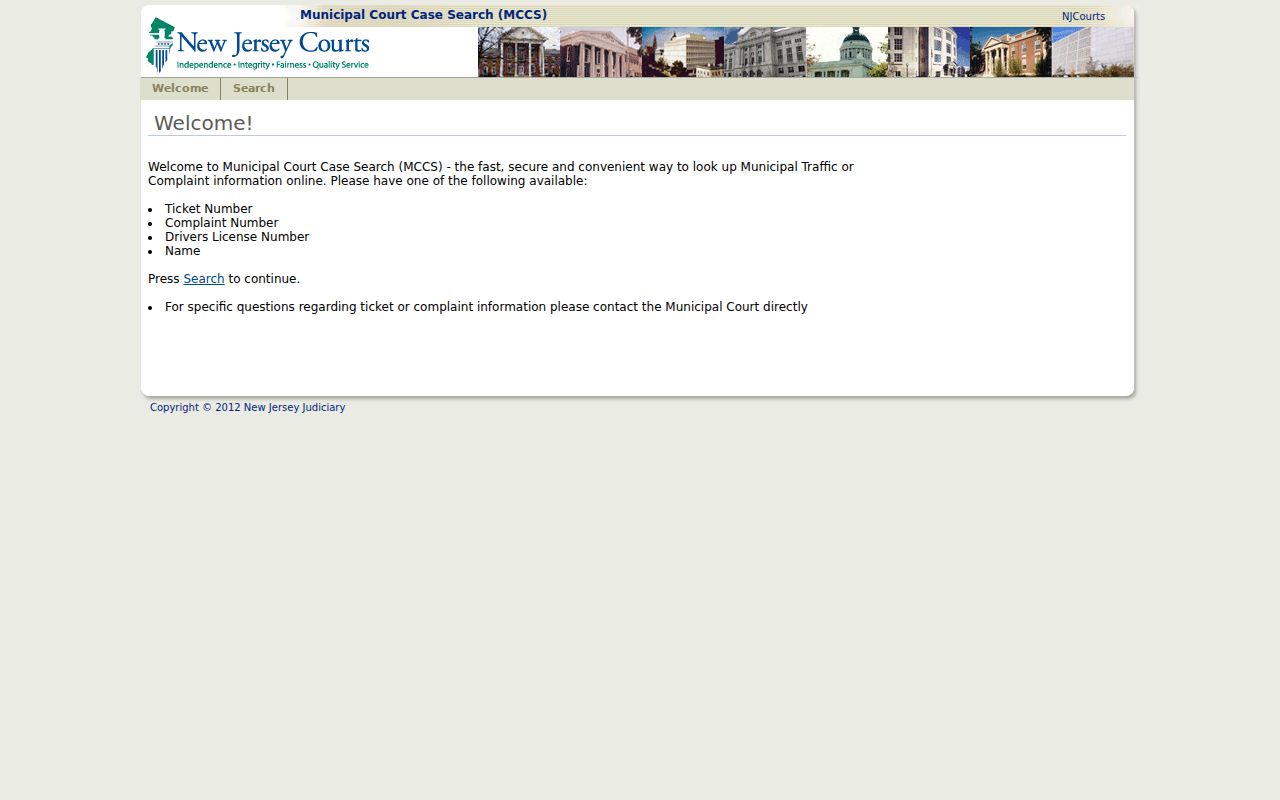
Lacey Municipal Court sits at 818 Lacey Road. It covers ordinance, traffic, disorderly-persons, non-indictable, and fish and game matters. Ocean Township, Waretown, and Pine Beach share the service. So check the venue, code, case caption, and complaint location. Do that before linking a party to Lacey Township. The court's local page links a municipal search route and records-request information. A municipal case is a lead, not a townwide person directory. Use the NJ Courts municipal case-search interface for the municipal route.
The NJ eCourts Public Access Case Jacket offers docket-number, party-name, and judgment tabs. The party route splits individual and business searches. Results include name, venue, docket number, case caption, and initiation date. Ignore the JOSHI RAVINDRA sample. It is a demonstration record, not a Lacey match. Individual searches are free. Verification steps, pagination, sealed cases, confidential matters, and copy rules still apply. Review the public case-jacket search route before entering a party or docket.
- Docket
- A court’s identifying case number, read with its venue, type, and year.
- Index versus image
- An index reports searchable record metadata; an image or copy is a separate record-access question and may have fees or restrictions.
- Certified copy
- A copy issued or certified by the custodian for the permitted purpose; it is not supplied by every public search result.
Keep Voter Status Separate From a Resident Lookup
New Jersey's "Am I Registered?" service lets a person check their own registration status, polling place, and related details. It is not a street-by-street public roll. Lacey's polling-place page can orient you to districts and facilities. Treat those assignments loosely. They change by election and never define residential boundaries. Broader Ocean County voter data follows a controlled route.
You need a signed OPRA request, plus an Election Order criteria form for a comprehensive voter list. The form can specify municipality, party, and election history. The county prices email as free, CD at 50 cents, and printed pages at stated copy rates, with special orders priced separately. Ask for a date-bounded Lacey Township extract. Keep its file format and redactions intact. Do not publish protected addresses, full birth dates, or unnecessary election-history detail.
Use Vital Records Only Through the Proper Custodian
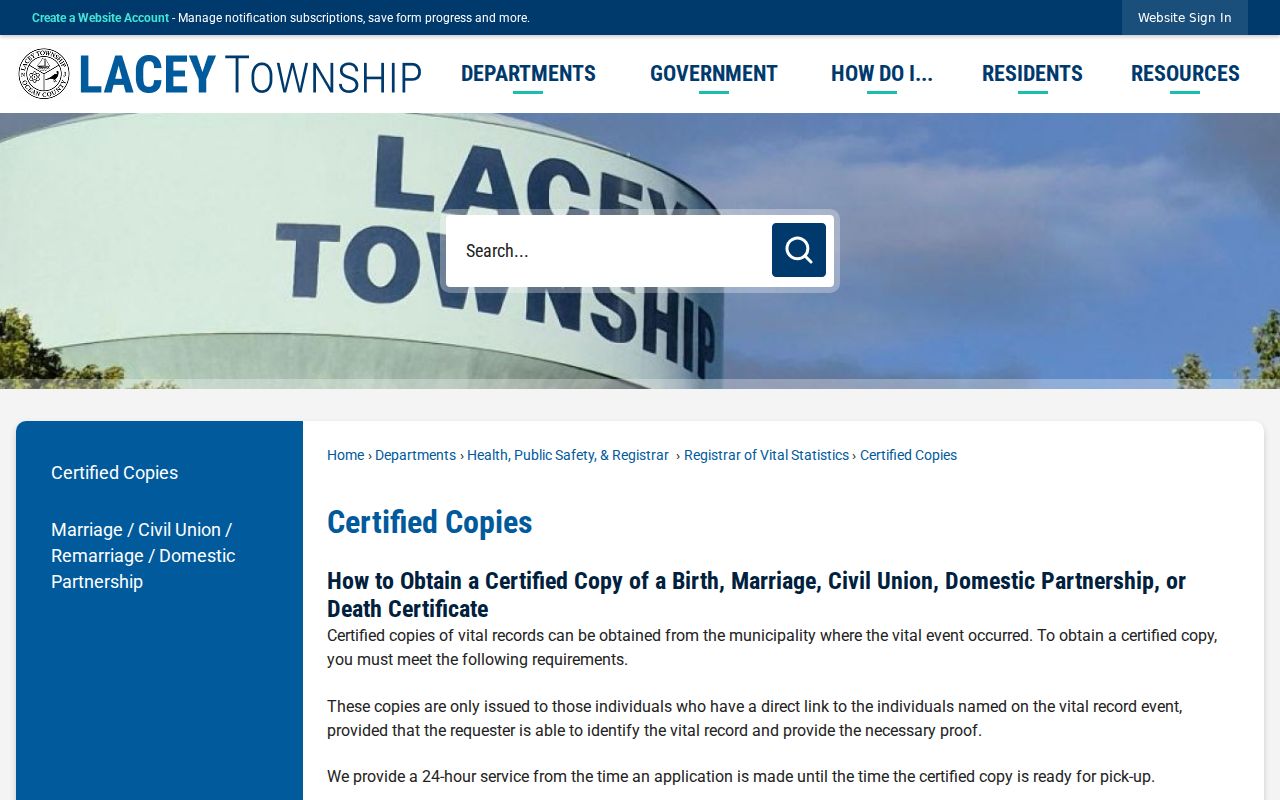
Lacey's Board of Health and Registrar handles qualifying local events. Statewide records go through the New Jersey Department of Health. Historical research belongs with the State Archives. The local counter charges $10 per certified copy. The state form prices its initial search and copy at $25. Additional copies in the same order run $2 each. Keep the two fee schedules and custodians straight. Open Lacey Township's certified-copy instructions when a local event is at issue.
Some records stay closed for good reason. Birth records within 80 years or involving a living person are restricted. So are marriages within 50 years, deaths within 40 years, and all civil-union and domestic-partnership records. Genealogy requests that reach past those thresholds use form REG-28A. REG-27A handles current, non-genealogical copies. A vital record proves one thing well. It documents the event, relationship, or date it reports, not where someone lives now.
Use Historical and Role-Based Records for Context
Older lookup work calls for sources bounded by time. The Ocean County Library's newspapers and genealogy holdings fit that role. So do the Wheeler Room's directories and phonebooks. OCHS family files fit as well. The State Archives do too. Pair a surname with Lacey Township, Forked River, Lanoka Harbor, or Bamber Lakes. You can also add a road, school, church, civic group, or year. A directory entry or an obituary can place a person in a moment. It cannot promise they still live there.
New Jersey's business entity and professional-license tools serve narrower purposes. They confirm an entity, a filing role, a license type, or a status. A registered agent, officer, manager, or licensee is a role on paper. It is not a home address. Use the Business Entity Name Search or MyLicense verification only for that stated purpose. Keep the status and retrieval date with whatever you save.
Privacy Boundaries for a Lacey Township Resident Lookup
An Open Public Records Act request goes to the custodian who holds an existing record. New Jersey has no general system for finding a person. OPRA, N.J.S.A. 47:1A-1 et seq., generally works on a seven-business-day response framework. Exemptions, redactions, and permitted extensions are tied to each record. So ask narrowly. Name a document, a date range, and a delivery method. Skip requests for explanations or broad dossiers.
Other protections matter here. Daniel's Law can redact covered public-servant household information. The Address Confidentiality Program gives eligible participants a substitute address in covered settings. A missing field may be a lawful shield. It is not a gap to fill from an unofficial source. Court, voter, vital, and parcel systems each carry their own limits too. Corrections go to the official custodian with a source link. They never go to a guess about present residence.
Lawful use. A Lacey Township resident lookup is for personal, lawful research with the minimum necessary information. Do not use any result to stalk, harass, intimidate, threaten, or harm a person; use the custodian’s correction or privacy process when a public record needs review.